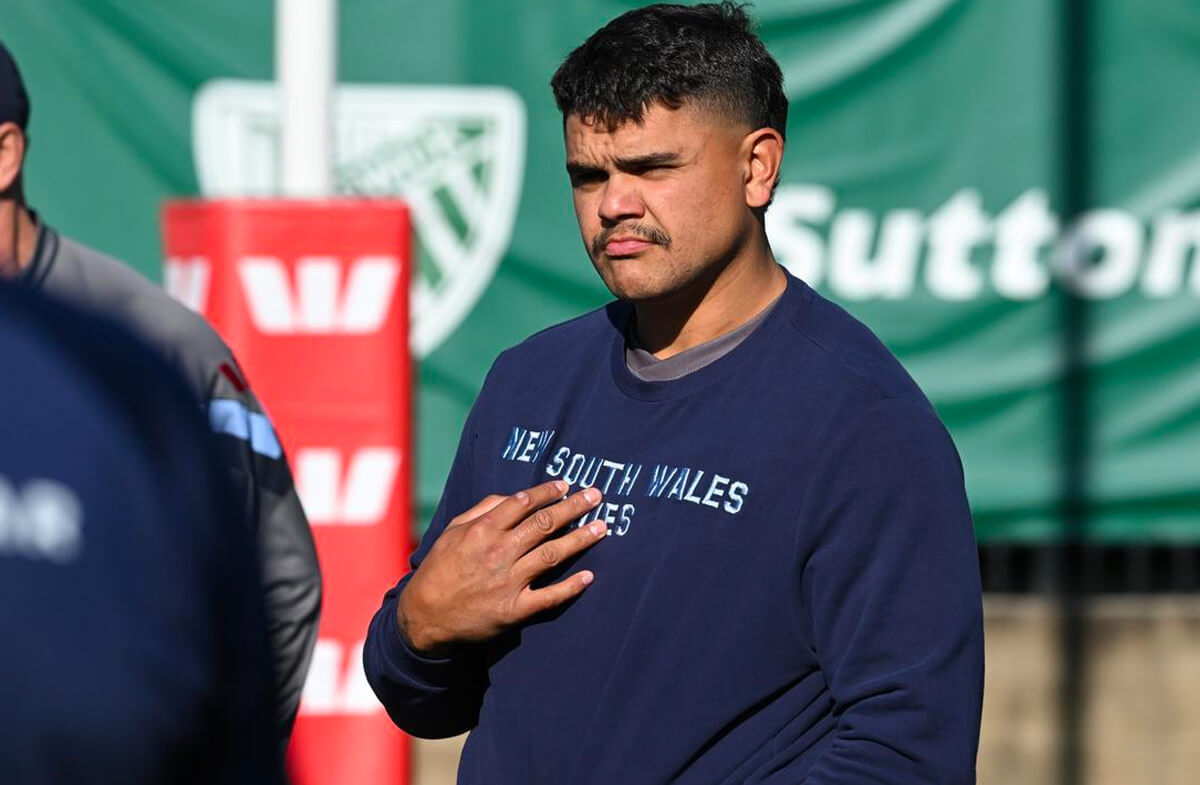
NSW has put its faith in Latrell Mitchell to rescue the 2024 series in game two at the MCG, ending the enigmatic match-winner’s three-year State of Origin hiatus.
Mitchell’s return shapes as arguably the most fascinating subplot of the do-or-die encounter; he’s been embroiled in controversy at South Sydney this year but comes into camp in great club form, while Queensland will have painful memories of his last dominant Origin foray in 2021.
Meanwhile, Queensland has turned a trio of discarded veterans – Felise Kaufusi and Kurt Capewell on the bench, and Dane Gagai as 18th man, all of whom last represented in 2021 – with injuries impacting a victorious series-opening line-up.
Mitchell’s sky blue renaissance, in particular, revives memories of some of the great representative revivals of yesteryear.
Max Krilich
A long-time hooker understudy to Fred Jones at club level, Krilich featured in Manly’s 1976 and ’78 grand final-winning sides – captaining the latter.
He also made his state and Test debuts and toured with the Kangaroos in 1978.
But Canterbury’s George Peponis usurped Krilich in the Australian side, while Steve Edge and Barry Jensen were preferred at hooker for NSW in the first two one-off Origin clashes.
The resilient Krilich skippered the Blues in all three matches of the inaugural 1982 series and captained Australia against New Zealand, before leading the Kangaroos on a historic unbeaten tour of Britain and France – a side forever immortalised as ‘The Invincibles’.
Krilich held onto the dual captaincy roles in 1983 but a neck injury forced the Sea Eagles great to retire at the end of the season.
Gavin Miller
Former Wests and Easts centre/five-eighth Miller played two Origins for NSW in 1983 after being transformed into a ball-playing second-rower at Cronulla, before a poor season back with the Roosters in ’84 left him at a crossroads.
But winning the coveted Man of Steel award during a decorated stint with Hull Kingston Rovers turned Miller’s career around and he returned to the Sharks.
As well as winning back-to-back Dally M Medals in 1988-89 (and sharing the Rothmans Medal with Mark Sargent in the latter year), the crafty, durable Miller represented Australia against Papua New Guinea, Rest of the World and in the World Cup final versus New Zealand in ’88.
Miller was then chosen as the Blues’ skipper in 1989 by coach Jack Gibson – who had lured Miller back to Cronulla three years earlier – after a six-year hiatus from the Origin scene.
While Miller’s performances were solid, Queensland subjected NSW to a 3-0 whitewash and the 29-year-old was left out of Australia’s squad for the subsequent tour of New Zealand.
Brad Izzard
Penrith powerhouse Izzard set a record for the longest gap between Origin appearances likely to stand the test of time, securing a NSW recall more than nine years after last donning the sky blue jumper.
The burly rookie’s first-grade career was only 13 games old when he was chosen at centre for the Blues in 1982, playing all three games of the inaugural series.
Izzard scored a try on debut in the series opener – the Blues’ maiden Origin win – and a produced a stunning 50-metre solo effort in game two, but Queensland fought back to take out the series.
Despite being touted as a future international and commanding a permanent spot in the burgeoning Panthers’ line-up at centre or five-eighth, Izzard struggled to shake the ‘enigmatic’ tag and became a rep footy pariah.
That changed ahead of the 1991 decider, however, when he was picked on the bench for NSW. Izzard help set up Michael O’Connor’s equalising try, but the Blues ultimately went down 14-12. He scored a vital try in Penrith’s historic grand final win later that year and retired in 1992.
Greg Florimo
Classy North Sydney centre/five-eighth Florimo received a NSW bench call-up for the 1988 dead-rubber. But despite being frequently mentioned as a contender, the ultra-consistent Bears stalwart seemed fated never to feature at the highest levels again.
A starring role in Norths’ stellar 1994 campaign catapulted Florimo into the Kangaroo Tour squad, however, and his versatility garnered an interchange role in two of the Ashes Tests.
The veteran duly played all three Origins for the Blues in 1995 and two Tests for Australia in the subsequent series against New Zealand. After a record 285 games for the Bears, ‘Flo’ finished his professional career with stints at Wigan and Halifax.
Geoff Toovey
Manly dynamo Toovey debuted off the bench for NSW in 1990 and wore the Australian No.7 in both end-of-season Tests against Papua New Guinea in 1991.
But Ricky Stuart had a mortgage on the NSW halfback role, while Illawarra teenager John Simon was preferred for the 1992 series opener with Stuart sidelined after Toovey endured a slow start to the season.
The Super League war ultimately opened the door for the courageous playmaker, ending a five-year Origin absence in the 1995 dead-rubber when he was chosen to replace Andrew Johns.
Toovey clinched the Test halfback job for the subsequent series against New Zealand and the Centenary World Cup triumph in England.
The half/hooker skippered Australia against Papua New Guinea in 1996 and led NSW to a series win in ’97 among an eventual tally of 13 Test and 15 Origin appearances to the end of 2000.
Mark Carroll
One of the most celebrated Australian Test bolters, ex-Penrith firebrand Carroll debuted for Australia against France in 1990 with just 26 first-grade games under his belt – despite playing for wooden spooners Souths.
‘Spud’ went on the Kangaroo Tour at the end of the year but faded out of view in subsequent seasons, until linking with Test coach Bob Fulton at Manly in 1994.
An unlucky omission from that year’s Kangaroo Tour squad, Carroll belatedly debuted for NSW in the Super League-affected 1995 series and won a Test recall mid-season against New Zealand before featuring in Australia’s World Cup triumph.
Carroll represented the Blues again in 1997 and ’99, while he played the last of 11 Tests in 1996.
John Simon
When Ricky Stuart was ruled out of the 1992 series opener, 19-year-old Illawarra halfback Simon jumped a queue of NSW No.7 contenders to debut – and played a key role in the Blues’ 14-6 victory in Sydney.
But the likes of Stuart, Toovey and Andrew Johns stood in his way in subsequent seasons, while an ill-fated stint at the Roosters did not help his representative aspirations.
A move to Parramatta in 1997 sparked a career-best season, however, with the Indigenous ball-player lining up in all three games of the Blues’ series victory and in Australia’s Test win over Rest of the World.
Simon gradually fell out of favour at the Eels and finished an admirable career with stints for Auckland Warriors and Wests Tigers.
Jason Croker
A bench debutant for NSW in 1993, the phenomenally versatile Croker was arguably the unluckiest player to miss out on the 1994 Kangaroo Tour squad after starring in Canberra’s premiership win.
Two years later, he was part of the history-making Blues side that carved out a 3-0 whitewash – the first time in Origin history a team has gone through a series using the exact same squad.
That appeared likely to be Croker’s rep swansong, but he received a surprise call-up for Australia’s 2000 World Cup campaign and made five Test appearances. Experienced at wing, centre, five-eighth, lock and second-row, a NSW recall followed for the 2001 series opener.
Matt Sing
Penrith winger/centre Sing’s rep ambitions were fast-tracked by the Super League war, playing a big part in Queensland’s shock 3-0 cleansweep in 1995 and earning a Test debut for Australia.
Sing, who joined the ARL-loyal Roosters, was a Maroons regular and an occasional Kangaroo for the next five years before becoming one of the scapegoats of the horror whitewash at the hands of the Blues in 2000.
But vintage form on the wing for the Cowboys sparked a renaissance in 2003: Sing played eight further Origins and 10 more Tests over the next three seasons, including scoring a record-equalling hat-trick for Queensland in the 2003 dead-rubber.
Scott Prince
Injury-prone former Cowboys and Broncos playmaker Prince played all three matches of the 2004 Origin series for Queensland after joining Wests Tigers, while he made his Test debut after captaining the joint venture to an extraordinary premiership triumph in 2005.
But the presence of Darren Lockyer and Johnathan Thurston blocked his path for further maroon and green-and-gold jerseys – until an injury to Lockyer in 2008.
Controversially overlooked for the Centenary Test and the Origin series opener following a sizzling start to 2008 for the Titans, Prince featured as Queensland came from a game down to retain interstate supremacy and played another two matches for Australia at the end-of-year World Cup.
Trent Barrett
Gifted Steelers and Dragons five-eighth Barrett played seven Origins for NSW and 15 Tests for Australia from 1997-2005, but a move to Wigan at the end of 2006 seemingly brought his representative days to an end.
Barrett returned to the NRL in 2009 with Cronulla, however, and answered an SOS from the beleaguered Blues, played in four Origins in 2009-10 – the last as captain of his state.
Luke Lewis
After starring in Penrith’s 2003 premiership triumph on the wing, Lewis’ Kangaroo Tour selection was ultimately overshadowed by Australian coach Chris Anderson’s controversial decision to instead select England-based veteran Darren Smith for the dead-rubber third Ashes Test against Great Britain.
Lewis played all three matches of NSW’s 2004 success but subsequently slipped down the Blues’ outside-back queue.
A shift to the Panthers’ back-row (after a lengthy stint in the halves) reinvigorated Lewis’ representative prospects, however, earning him a NSW recall and a Test debut in 2009.
Lewis, who linked with Cronulla in 2013, signed off on a 17-game Blues tenure in the drought-breaking 2014 series win and played the last of his 16 Tests the following season.
Trent Waterhouse
Similar to Penrith teammate Lewis, back-rower Waterhouse parlayed the Panthers’ premiership triumph into a 2003 Kangaroo Tour berth and a NSW debut in 2004. He represented Australia again in 2004-05 before slipping down the pecking order.
Again like Lewis, Waterhouse earned a recall in 2009, playing in the Blues’ dead-rubber win – but becoming the first NSW player to get sent off in Origin football, albeit controversially – and featuring in the Kangaroos’ Four Nations campaign at the end of the year.
Waterhouse played the last of his five matches for NSW in 2010.
Willie Tonga
Ex-Parramatta centre Tonga became one of the game’s hottest properties after joining the Bulldogs in 2004, winning a Queensland call-up (and scoring a try on debut) after just 20 NRL appearances and breaking into Australia’s Tri-Nations-winning line-up at the end of the year.
But he faded from the selectors’ view due to injuries and indifferent form in the ensuing four seasons.
Tonga linked with North Queensland in 2009 and received a Maroons lifeline for game two of that year’s series when Justin Hodges was ruled out injured; ironically, Tonga got his initial Origin start five years earlier at the expense of the dumped Hodges.
That started a run of six straight matches for Queensland, while he played another five Tests for the Kangaroos in 2010-11.
Anthony Minichiello
The 2005 Golden Boot recipient and a veteran of 18 Tests for Australia, Minichiello seemed destined to join the ranks of Australia’s greatest fullbacks before a horror run of injuries struck the Roosters star down in his prime.
Minichiello played just 33 NRL games from 2006-09. But the popular custodian fought back courageously, winning a recall to the NSW Origin side in 2011 and captaining the Roosters to grand final glory two years later.
Missing just nine club games in his last five campaigns, Minichiello retired at the end of 2014 with club records for most games (302) and tries (139) in the tricolours.
Corey Parker
Goalkicking back-rower Parker made three interstate appearances during Queensland’s 2004-05 series losses but fell off the selectors’ radar – despite playing a key role in Brisbane’s 2006 premiership success and becoming a regular fill-in captain at the club.
But a stellar start to 2011 saw Parker end a six-year Origin exile, chosen on the bench for all three games of the Maroons’ sixth straight series triumph.
Rapidly developing into one of the NRL’s premier forwards, the 29-year-old played the first of 13 Tests for Australia at the end of the year and had racked up 19 matches for Queensland by the time he retired in 2016.
James Maloney
Former Warriors linchpin Maloney earned a NSW call-up after a superb start to his stint with the Roosters in 2013. But after another series failure, he joined a long line of Blues halves discards.
NSW turned to Maloney again in 2016, however, featuring in 11 of 12 Origins – including a starring role in series wins in 2018-19.
The dual premiership winner also won selection in Australia’s 2016 Four Nations and 2017 World Cup squads, cementing a legacy as one of the decade’s most influential playmakers.
Daly Cherry-Evans
Manly halfback wunderkind Cherry-Evans debuted for Australia at the end of his remarkable 2011 rookie season, before assuming the bench utility role in the Maroons and Kangaroos line-ups in 2013.
But DCE was seemingly on the representative scrapheap after starting in all four Tests of Australia’s unsuccessful 2014 Four Nations campaign and Queensland’s loss in game two of the 2015 series, while his high-profile backflip on a deal with the Titans sullied his reputation with fans in his home state.
The Maroons turned to the in-form Sea Eagles skipper ahead of the 2018 dead-rubber, however, and he performed brilliantly in a face-saving 18-12 win in Brisbane. Cherry-Evans capped an extraordinary turnaround with a Test recall at the end of 2018.
Cherry-Evans has now played 21 Tests for Australia and 23 Origins for Queensland (the last 16 in a row), leading the Maroons to series triumphs in three of the past four years.