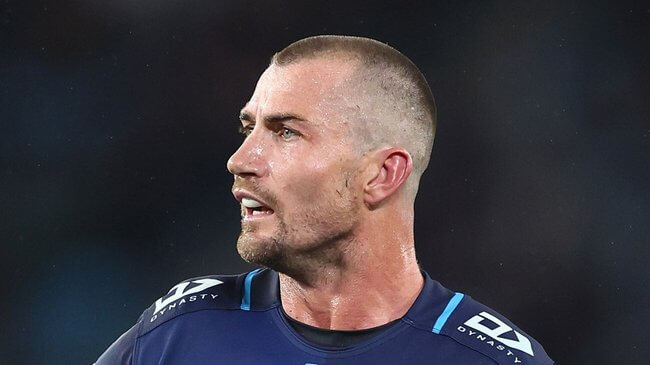
Manly and St George Illawarra swung the axe on under-pressure coaches Anthony Seibold and Shane Flanagan, respectively, earlier this season – pitching Kieran Foran and Dean Young into the caretaker hotseat.
Against the odds, Foran and Young have both turned the ailing clubs’ fortunes around to varying degrees to secure permanent head coach roles.
Most mid-season sackings result in recruiting the next cabs off the coaching rank for the following season, so we’re pinpointing every interim mentor to have been promoted to the fulltime gig.
Ray Stehr
Manly’s inauspicious 0-5 start to their inaugural 1947 campaign saw the club make the rash decision to punt coach Harold Johnston, a former North Sydney player.
Legendary ex-Eastern Suburbs and Australian Test prop Stehr – who had only hung up the boots after captain-coaching Easts in 1946 – was approached to take over in an interim capacity.
Manly improved under his direction, winning four of their remaining 13 games to avoid a debut-season spoon. But after a meagre four-win season in 1948, the club handed the reins to former Balmain prop George Mullins and Stehr returned to the helm at Easts.
Barry Harris
A former NSW forward while playing for Newtown before stints with Souths and Penrith, Harris took over the Panthers’ coaching reins for the last six rounds of 1975 when English hooker and captain-coach Mike Stephenson relinquished the latter duties.
The ‘Chocolate Soldiers’ won eight games and finished ninth in 1976 under Harris but he was replaced by former Test fullback Don Parish the following season.
David Waite
Newcastle’s reserve grade coach during the club’s first four seasons, former Test winger Waite was bumped up to caretaker first-grade coach duties with eight rounds of the 1991 campaign remaining after the sacking of foundation mentor Allan McMahon.
Waite was appointed to the role fulltime and guided the Knights to their first finals series in 1992, but underwhelming follow-up seasons resulted in the club showing him the door at the end of 1994. British great Mal Reilly took over and led Newcastle to its first premiership within three years.
Royce Simmons
Following premiership coach Phil Gould’s abrupt departure from Penrith towards the end of 1994, his former skipper Simmons stepped into the breach. Three wins from the last six rounds was enough for the Panthers to give the job to the 35-year-old fulltime.
Simmons became Penrith’s longest-serving coach to that time despite modest results. He led the Panthers to the finals in 1997 and 2000 but was replaced following the team’s 2001 wooden spoon season. The popular former Test hooker was part of Tim Sheens’ title-winning staff at the Tigers.
Frank Endacott
High-profile Warriors foundation coach John Monie was pushed out midway through 1997, catapulting New Zealand Test coach Endacott – the Warriors’ reserve grade mentor since their inception – into the first-grade hotseat.
Improved results towards the end of the season and a strong World Club Challenge showing saw ‘Happy Frank’ hang onto the job.
Despite luring several Kiwis stars to Auckland in 1998, the Warriors won only nine games and he made way for Mark Graham when the club underwent an ownership change.
Murray Hurst
Relative unknown Hurst came in as the Cowboys’ interim coach after Tim Sheens’ acrimonious split with the underperforming club midway through 2001. He was retained despite managed just four wins in the last 15 rounds.
But former Tonga World Cup coach Hurst himself was unceremoniously axed following a 0-3 start to 2002, with Graham Murray taking over and belatedly leading the Cowboys to NRL relevance.
Tony Kemp
The Warriors’ early-2000s golden era fell apart in rapid and dramatic fashion, leading to coaching saviour Daniel Anderson’s exit midway through 2004.
Anderson’s assistant since taking over in 2001, 25-Test Kiwi Kemp, was handed the reins in difficult circumstances and was forced to blood a host of teenagers across the last 13 rounds – which garnered just three wins.
The Warriors improved significantly under Kemp in 2005 – winning 10 games and finishing only four points adrift of the finals – but he was brushed aside for coaching prodigy Ivan Cleary to slot in as head coach at the end of the year.
Brad Fittler
When Chris Anderson’s stint as Roosters coach came to an end after just 16 games, 35-year-old club legend Fittler filled the caretaker role – and five wins and a draw from the last eight rounds got him the job permanently.
‘Freddy’ steered the Tricolours to a top-four finish in 2008, but a diabolical wooden spoon campaign in 2009 – during which his drunken indiscretion was among a plethora of off-field atrocities for the club – he stepped down and never coached in the NRL again, though he did lead NSW for six series.
Rick Stone
Long-serving assistant Stone stepped into the breach when Brian Smith quit the finals-bound Knights with just four rounds of the 2009 season remaining.
Stone kept the head coach job for the next two years – including a finals appearance in 2011 – but reverted to an assistant role when Wayne Bennett arrived. Bennett departed a year early and Stone took over for 2015, but he was axed by the battling Knights with six rounds left.
Andrew McFadden
Matt Elliott’s stay at the Warriors last just five games into his second season, exiting in early-2014 after a heavy loss at Cronulla.
Previously on Elliott’s staff at Canberra before coming on-board with the Warriors as his assistant, McFadden shone immediately as caretaker and the team only missed the 2014 finals on for-and-against.
Season-ending injuries to Shaun Johnson in 2015 and Roger Tuivasa-Sheck in 2016 foiled his bid to end the Warriors’ Top 8 drought after taking on the job fulltime and he slipped back into an assistant role under Stephen Kearney for two seasons, then joined Ricky Stuart’s ranks at Canberra.
‘Cappy’ returned to the Warriors in 2023 as general manager of recruitment and development.
Paul McGregor
The joint venture’s inaugural captain, McGregor was on Wayne Bennett’s Dragons staff and was installed as interim head coach after Steve Price’s sacking during 2014.
‘Mary’ was promoted to permanent head coach and guided the Saints to finals appearances in 2015 and 2018, but he was let go with 10 rounds of the 2020 season remaining – heralding the musical chairs period the club is still enduring.
Neil Henry
Henry was out of a head coach role for less than a year after seven seasons with Canberra and North Queensland, taking over from Gold Coast’s foundation mentor John Cartwright with four rounds of the 2014 season left.
He turned the Titans around sufficiently to earn a finals appearance in 2016, but a poor follow-up campaign led to his departure with two games remaining in 2017.