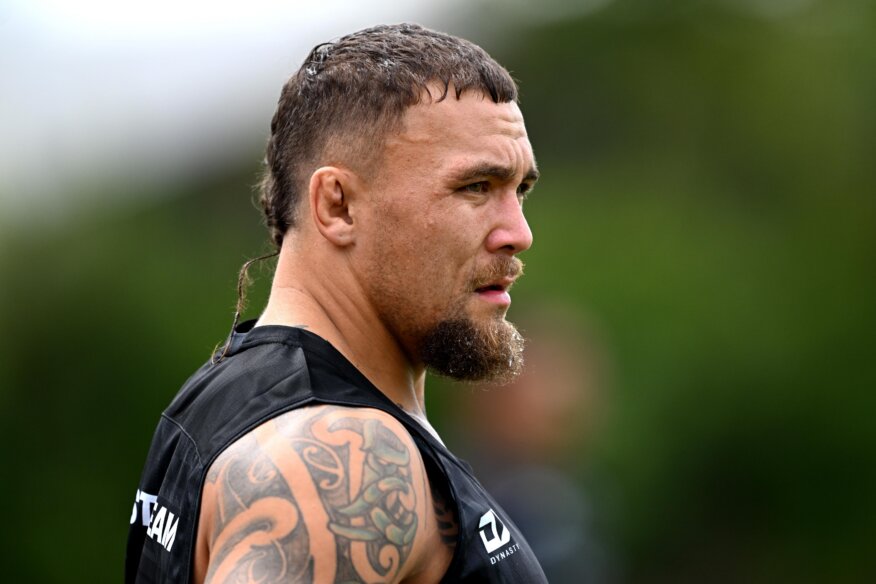
After leading a historic haka before starring in an equally momentous victory against his former team, it’s clear Warriors co-captain James Fisher-Harris – a revered four-time premiership winner with Penrith – is on his way to dual club icon status.
Countless players have made an impression at multiple clubs, but we’re profiling those who achieved genuine legend standing in more than one jersey, along with a few other two-club trailblazers and record-breakers.
Harold Horder (South Sydney and North Sydney)
The greatest winger of rugby league’s formative era, Horder scored an astonishing 152 tries in just 136 games – a strike-rate no player since has come close to approaching.
Horder was a phenomenon for Souths from 1912-19, winning two premierships, then joined Norths for four seasons – skippering the club to its maiden title in 1921 and starring again as they went back-to-back (under Duncan Thompson’s captaincy) in 1922.
The champion flankman returned to Souths for a farewell season in 1924, captaining the club in its premiership final loss to Balmain before finishing his career in Brisbane. Horder scored 102 tries in 86 games for the Rabbitohs and 50 tries in 50 appearances for the ‘Shoremen’.
Ken Irvine (North Sydney and Manly)
North Sydney’s greatest-ever player and arguably the finest winger to play the game, Irvine scored 171 tries in 178 games for the hapless Bears – featuring in just three finals matches in his 13-season tenure.
At the age of 31, the 33-Test champion joined bitter neighbouring rivals Manly and helped the club to its first two premierships in 1972-73. He retired after the Sea Eagles’ bloody grand final win over Cronulla in the latter year, having scored 41 tries in 60 games for Manly.
The Australian Team of the Century winger would have been the first player picked in North Sydney’s Team of the Century, while last month he was chosen as one of the wingers in a fan-voted Manly fantasy team to mark the club’s 80th season.
Ron Coote (South Sydney and Eastern Suburbs)
The era’s standard bearer for becoming a legend at multiple clubs, champion lock Coote departure from Souths at the end of 1971 was no surprise after he had become embroiled in a contract dispute earlier that year – but it nevertheless increased tensions between two bitter rivals.
After 148 games for the Rabbitohs that included six grand finals and four premierships, Coote joined Easts and captain the club in its 1972 grand final loss, before starring in the Roosters’ 1974-75 triumphs under Arthur Beetson among 109 appearances.
As folklore has it, a Souths-mad couple had a pet rabbit called Ron Coote…which they cooked and ate after he switched clubs. The Rabbitohs and Roosters have played for the Ron Coote Cup since 2007, in honour of the Australian Team of the Century second-rower and eventual Immortal.
Roy Ferguson (Western Suburbs and St George)
Wyong-bred centre Ferguson is hardly a household rugby league name – even among fans of the teams he played for – but he holds a niche in premiership history as the first player to make 100 top-grade appearances for two different clubs, achieving the feat the season prior to Coote.
Tough as nails, Ferguson played 101 games for the Magpies from 1964-71 (he attempted to join Manly in 1968 but Wests put a $10,000 transfer fee on his head), before linking with the Dragons and playing an even 100 games from 1972-76.
Ferguson was one of the Saints’ better performers in their record-breaking 38-0 loss to Easts in the 1975 grand final.
Steve Edge (St George and Parramatta)
Determined hooker Edge became the third player to make 100 top-grade appearances for two clubs – 103 for St George, 118 for Parramatta – but his greatest rugby league claim to fame is being the only player to captain two different teams to grand final victories.
Edge led the Dragons to the 1977 premiership in a historic grand final replay win over the Eels, who he joined after playing in another Saints triumph (under Craig Young) in 1979.
He was installed as Eels captain by Jack Gibson in 1981 and led the long-suffering club to a title threepeat, as well as a grand final loss to Canterbury in 1984, the last match of his admirable career.
Brad Fittler (Penrith and Sydney Roosters)
Penrith prodigy Fittler’s 119 games for the Panthers included a grand final appearance as an 18-year-old and a key role in their maiden premiership at 19, while he was frequently thrust into the beleaguered club’s captaincy in ensuing seasons.
Signing with the ARL amid the Super League war (the Panthers went with the rebel organisation), Fittler reunited with former coach Phil Gould at the Roosters – and ultimately became the first player to make a century of appearances for one club and 200 for another.
Fittler went on to skipper the Roosters in four grand finals, including a drought-breaking victory in 2002. He retired after the loss to the Bulldogs in the 2004 decider.
Glenn Lazarus (Canberra, Brisbane and Melbourne)
Still the only player to win grand finals with three different clubs, Lazarus was the front-row cornerstone of Canberra’s, Brisbane’s and Melbourne’s maiden premiership triumphs.
The Queanbeyan product featured in the Raiders’ 1989-90 grand final wins but departed after their loss in the ’91 decider in the wake of the club’s salary cap scandal. He joined the Broncos and proved the missing piece of the star-studded outfit’s premiership puzzles, helping them to the 1992-93 titles.
A knee injury ruled him out the Broncos’ run to the 1997 Super League premiership, but he was invaluable as the Storm’s inaugural captain and retired in glory after skippering the fledgling outfit to victory in the 1999 grand final.
The 22-Test veteran played 92 games for the Raiders, 118 for the Broncos and 44 for the Storm. He was named in greatest-ever line-ups to mark Canberra’s 40-year, and Brisbane’s and Melbourne’s 25-year anniversaries.
Darren Smith (Canterbury and Brisbane)
Reaching 100 appearances for Canterbury was bittersweet for Queensland centre/back-rower Smith, for he was controversially left out of the Bulldogs’ next game – the 1994 grand final – by coach Chris Anderson after he opted to sign elsewhere.
Smith vindicated the move to Brisbane by scoring 56 tries in 87 games across four seasons, winning grand finals in 1997-98 – including a club-record-equalling and NRL-high 23 tries in the latter campaign.
Reuniting with the Bulldogs in 1999, he spent four seasons back in the blue-and-white jersey to join just a handful of players to have scored 50-plus tries for two clubs.
The evergreen Smith, who played 22 Origins along with seven Tests for Australia, left for St Helens after the Bulldogs’ 2002 salary cap scandal but made a surprise return for the Broncos in 2004-05 to pass 100 appearances for the club.
Ruben Wiki (Canberra and Warriors)
A grand final winner with Canberra in his first full season of first grade in 1994, blockbusting Kiwi Wiki was embroiled in a legal dispute after signing for both the Raiders and the incoming Warriors for 1995.
Eventually allowed to stay with the Raiders, the centre-turned-forward enforcer went on to play 224 games for the club but belatedly returned home in 2005 and enjoyed a celebrated four-season, 87-game stint with the Warriors.
The inspirational Wiki played a then-world record 55 Tests for New Zealand and became the first non-Australian to make 300 premiership appearances.
Steve Price (Canterbury and Warriors)
Toowoomba product Price played 222 games for the Bulldogs from 1994-04 – including three grand finals and a premiership triumph in 1995 – but was agonisingly ruled out of captaining the club in the 2004 decider by injury ahead of his move to the Warriors.
Joining the Auckland-based club alongside Wiki, Price became one of the Warriors’ greatest-ever imports, winning Dally M Prop and Captain of the Year honours in 2007 and leading them to another finals series in 2008.
A career-ending foot injury forced Price into retirement without taking the field in 2010, halting his tally of games for the Warriors at 91.
Braith Anasta (Canterbury and Sydney Roosters)
The Dally M Rookie of the Year and a teenaged Kangaroo tourist in 2001, Anasta was the unwitting face of the Bulldogs’ salary cap scandal the following season but remained to star in the club’s 2004 premiership triumph.
After 110 games for the Bulldogs, the five-eighth moved to bitter rivals the Roosters, where his 147 appearances across seven seasons including 98 games as captain. He led the club on its memorable charge to the 2010 grand final but finished his NRL career in 2014 after two seasons with the Tigers.
Luke Lewis (Penrith and Cronulla)
A teenaged winger in Penrith’s 2003 grand final victory, Lewis went on to become one of the era’s most versatile players – moving to centre, then the halves and finally the back-row, which sparked a representative renaissance.
After 208 games for the Panthers (and a contract back-flip on Souths), Lewis joined Cronulla in 2013 and played another 116 NRL matches – including a Clive Churchill Medal-winning performance as the Sharks collected their maiden premiership in 2016.
Lewis and fellow Panthers junior Fittler are the only players to make 200 appearances for one club and 100 with another.
Greg Inglis (Melbourne and South Sydney)
One of the most gifted players of all time, Inglis scored 78 tries in 117 games for Melbourne as a rookie winger, fill-in fullback, superstar centre and Churchill Medal-winning five-eighth.
‘GI’ left the Storm in the wake of the Storm’s flagrant salary cap breach, sensationally reneging on a contract with Brisbane to link with Souths in 2011. He was the marquee man at fullback as the Rabbitohs ended a 43-year premiership drought in 2014.
Inglis took over as club captain in 2016 and racked up 71 tries in 146 games for Souths before injury forced the veteran of 32 Origin and 39 Tests into retirement in 2019.
Tohu Harris (Melbourne and Warriors)
Workhorse Kiwi forward Harris made exactly 117 appearances for both the Storm and Warriors, leaving an impressive legacy at both clubs.
Harris’ five seasons with Melbourne culminated in grand final glory in 2017 ahead of his move back to New Zealand.
An inspirational leader whose seven seasons with the Warriors were punctuated by serious injuries, Harris nevertheless won two Simon Mannering Medals as the club’s Player of the Year and enjoyed arguably the finest season of his career as captain of their unforgettable top-four rise in 2023.