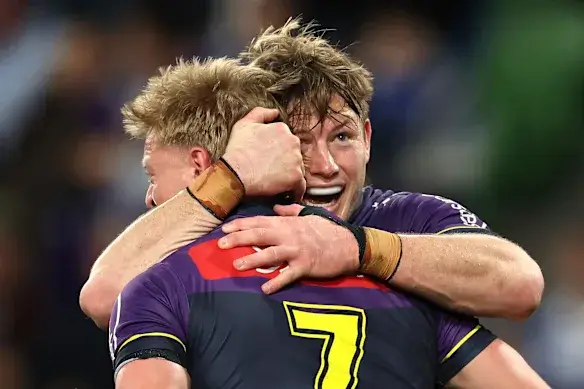
The NRL’s move to a six-man bench in 2026 has subtly changed the role of the utility, allowing coaches to select more specialists on the interchange.
But versatility will always remain a valuable commodity in rugby league, while players who have been able to command a spot in their team in multiple, disparate positions – or plug a troublesome gap amid an injury crisis – have always held a certain fascination among fans.
This week we’re paying tribute to the most adaptable, multitalented all-rounders the game has produced.
Jimmy Craig
One of the most iconic and influential figures of Rugby League’s formative decades, Craig won four premierships with Balmain (1915-17 and 1919-20) and captain-coached Western Suburbs to its maiden title in 1930.
He played seven Tests against England between 1921 and 1928, was inducted into the ARL Hall of Fame in 2005 and was named as a reserve in Queensland’s Team of the Century in 2008.
But another lasting impression of Craig is his status as the game’s first great utility, as his nickname ‘Mr. Versatile’ attests.
Capable of playing in any position on the field, Craig made his Test debut as a centre on the 1921-22 Kangaroo Tour. He captained Australia in the 1924 home series against the Old Enemy – from halfback in the first Test and at centre in the remaining two encounters.
Craig’s played fullback and centre against the touring Englishmen, and even played hooker for New South Wales on a tour to New Zealand in 1922 – back in the days when scrums were a contest and only the fearless packed down in the front -row – while he filled in at lock and on the wing at club level.
Greg Hawick
South Sydney star Greg Hawick was regarded as the finest utility of the 1950s. Emerging as a lock, Hawick played five-eighth in the Rabbitohs’ 1950 premiership-winning side – his first season in the top grade.
Hawick was a centre in Souths’ victory in the first mandatory grand final in 1954, and played nine Tests between 1952 and 1958 – three at five-eighth, three at halfback, two in the centres and one at lock. In 2006, Hawick was named at pivot in the Team of the 1950s.
Des Hasler
Manly great Des Hasler’s biography was entitled The Utility Player – a fair indicator to his unparalleled versatility. But Hasler was no spare-parts competitor.
One of the best halfbacks of the 1980s, Hasler successfully switched to the back-row in the early-1990s and was a premiership-winning hooker in the twilight of his career, while he was also capable of filling any position in the backline.
The Penrith junior joined Manly and made his Australian debut at halfback in 1985 but his versatility was crucial to his selection for the 1986 and 1990 Kangaroo Tours – and to his selection on the bench for nine of his 12 appearances for Australia.
The super-fit Hasler started half of his 12 Origins for NSW on the bench and made starts at halfback, five-eighth and lock. He won two Grand Finals with Manly, in 1987 wearing the No.7 and 1996 as a hooker, while he was named Dally M Lock of the Year in 1991.
Phil Blake
A teenaged halfback sensation with Manly in 1982-83, the mercurial Blake was shunted to centre and then wing – with the occasional stint at five-eighth – before linking with Souths, where he was predominantly a fullback or five-eighth in four seasons.
The potent try-poacher flitted around the team sheet in short stays with Norths, Canberra and St George, then became the Warriors’ inaugural fullback. After a then-audacious shift to hooker with the Auckland club, he also had a game at lock before hanging up the boots in 1997.
John Plath
Initially a disadvantage in securing a top grade berth with Brisbane, Plath’s versatility saw him win a grand final in his 10th first grade game and become a crucial element of the glamour club’s success during the 1990s.
Plath was predominantly a half early in his career, making his debut in 1990, although his path was blocked by the incomparable pairing of Allan Langer and Kevin Walters. But he forged a spot on the bench late in 1992 – just in time to celebrate in the Broncos’ maiden premiership victory.
The tenacious, chirpy Plath was a permanent member of the first-choice squad for the next six seasons, coming off the bench in three more grand final triumphs.
He made 99 of his 149 Broncos appearances from the bench, but exhibited his adaptability with starts at centre, five-eighth, halfback, hooker and lock without missing a beat.
Steve Georgallis
An underrated veteran of 206 games in a 12-season first grade career, Steve Georgallis was one of the most versatile players of the 1990s.
Georgallis made his debut for Easts in 1989 as a half but he is best remembered as a mainstay for Western Suburbs from 1993 until their demise at the end of the decade, and as an integral member of the inaugural Wests Tigers squad in 2000.
Georgallis played most of his football at halfback, five-eighth and lock, but also spent time at fullback, centre, hooker and off the bench.
Jason Croker
Canberra champion Croker emerged as a teenaged winger in 1991 before switching to lock two years later. He played five-eighth for much of 1994 with Laurie Daley sidelined but started in the second-row in the Raiders’ grand final victory, desperately unlucky not to go on the subsequent Kangaroo Tour.
Centre was his most regular spot over the next couple of years, before having solid stints at five-eighth, lock and second-row again before his 318-game career wound up in 2006.
Croker belatedly earned an Australian call-up for the 2000 World Cup, coming off the bench four times and scoring two tries as a winger in a world record win over Russia – the same season he was named Dally M Lock of the Year.
Shaun Berrigan
Breaking into the Broncos’ line-up as a bench player in 1999, Berrigan filled in at centre and five-eighth before making the halfback jersey his own in 2001. Allan Langer’s return saw him move to five-eighth in 2002 (as well as having a stint at hooker) and they paired up in the halves for Queensland.
Berrigan took over the No.7 jerseys at club and Origin level in 2003 before he made and outstanding switch to centre in 2004 that garnered an Australian Test debut in the position. A shift to hooker late in 2006 proved crucial to the Broncos’ premiership triumph with Berrigan winning the Churchill Medal.
He became the go-to bench utility for Queensland and Australia before heading to Super League – mostly playing in the halves and at hooker for Hull FC – while he was mostly used at centre and hooker in short stints with the Warriors and Raiders following his NRL return.
Craig Wing
Craig Wing’s supreme athleticism saw him start in every position in first grade except prop and second row, while his versatility was the key to a fine representative career that yielded 16 Tests for Australia and 12 Origin appearances for NSW.
In his 1998 debut season for Souths, he played at halfback, five-eighth, lock, centre and wing, showing an astonishing amount of versatility for a rookie, before becoming a fullback sensation for the Rabbitohs in 1999.
Wing came off the bench in the Roosters’ 2000 grand final loss and was a key figure at halfback in their premiership win two years later, but switched to hooker in 2003 (playing in two more deciders) and becoming a Blues and Kangaroos bench regular.
Wing started 10 Tests on the bench, one at five-eighth and two at hooker, while he played all three Ashes Tests on the 2003 Kangaroo Tour in the centres following an injury crisis within the inexperienced squad.
Casey McGuire
Essentially the Broncos’ successor to Plath – an interchange specialist who could slot in anywhere on the team sheet and perform at a high level – McGuire (not to be confused with recent NSW debutant Casey McLean) played 249 NRL and Super League games for Brisbane, Parramatta and Catalans.
Of those appearances, 72 were off the bench, 75 came at hooker, 46 at five-eighth, 43 at halfback, eight at centre, three at lock, and one each in the second-row and at lock.
McGuire also won a First Division grand final with the Eels at fullback in 1999 and played one Origin for Queensland as an interchange in 2005.
Kurt Gidley
Before becoming the resident NSW and Australia bench utility as simultaneously one of the best halfbacks and fullbacks in the game, Gidley slotted in all over the Newcastle backline in the first half of the 2000s – at five-eighth, centre, fullback and halfback.
Taking over the No.7 during Andrew Johns’ long injury absences, he reverted to five-eighth when ‘Joey’ returned but mostly played fullback from the Knights from 2007 until his Super League departure in 2013.
Gidley created history by captaining NSW from the bench in 2010 and was a dummy-half and middle forward option at Test and Origin level, while he ultimately started 19 NRL games at hooker.
Lance Hohaia
The ‘Huntly Hurricane’ chalked up double-digit appearances for the Warriors at fullback (48 games), five-eighth (44), centre (15), hooker (14), halfback (10) and as an interchange (54) during a decorated decade at the club.
Initially a half, Hohaia had stints at hooker in 2005 and centre in 2006-07, before his stellar performances at fullback in the Warriors’ drive to the 2008 and ’10 finals saw him star in the Kiwis’ subsequent World Cup and Four Nations triumphs in those seasons.
Hohaia reverted to a bench utility role for much of 2011 but started the grand final – his last game for the Warriors – at hooker.
Luke Lewis
Lewis burst onto the scene for Penrith as a teenaged winger, winning a premiership and Kangaroo Tour call-up in 2003. He broke into the NSW team the following season, playing wing and centre.
Occasionally filling in at five-eighth and second-row in subsequent seasons, he made a shock move to halfback for the struggling Panthers in 2008, while a shift to lock in 2009 sparked Origin and Test recalls. During the 2011 Four Nations, he moved to the wing midgame against England and scored a try.
Lewis’ six-season stay with the Sharks – which included a Churchill Medal in the 2016 grand final win – was predominantly as a second-rower, but he still filled in at five-eighth and centre on occasion.
Chris Flannery
After debuting for the Roosters in 2000, the Cowra-born and Sunshine Coast-raised Flannery split his duties between fullback and wing in 2001, with cameos in the centres and at halfback.
Flannery became a genuine Mr. Fix-it in 2002, playing in a new spot virtually every week – in 21 appearances he played in the same position in consecutive weeks just five times. He played fullback during the finals campaign at fullback before coming off the bench in the 2002-04 grand finals.
Flannery’s versatile talents were frequently required at five-eighth in 2005, before he settled in the back-row for most of 2006 – probably his best-suited position.
In 10 Origin appearances for Queensland, Flannery came off the bench six times, started at lock in three games and stood in for injured skipper Darren Lockyer at five-eighth for one match in 2004.
Mitch Aubusson
Roosters triple centurion Aubusson made over 100 NRL starts at centre and in the second-row, but he was an invaluable gap-plugger from the bench or switching positions to cover mid-game contingencies.
The underrated and ultra-consistent member of the Roosters’ 2013 and 2018-19 grand final triumphs also started a handful of games at lock, five-eighth and hooker.
Tyrone Peachey
Predominantly utilised as a centre, Peachey regularly featured at five-eighth, second-row and lock, as well as playing a handful of games at fullback and hooker during a 209-game career with the Sharks, Panthers, Titans and Tigers.
The livewire was an ideal bench weapon and came off the pine in all three games of NSW’s 2018 Origin campaign.
Dylan Walker
A premiership-winning and Australian Test centre within two years of his 2013 NRL debut with Souths, Walker frequently found himself occupying the five-eighth and fullback role with Manly, while he also had starts at hooker and halfback for the Sea Eagles.
Walker gravitated to a bench utility role at Manly, while he was almost exclusively used as a middle forward in two and a bit seasons with the Warriors – though he also had stints at five-eighth and second-row with the club.
The 2016 NSW Origin centre has played at lock and off the bench since linking with Parramatta last year, passing the 250-game milestone in first grade.
Connor Watson
First shooting to prominence as a Nines star for the Roosters, the multipurpose Watson had stints at five-eighth and fullback before embarking on a four-season stay with Newcastle, where he expanded his repertoire to hooker and lock.
The dummy-half/middle forward roles have been his main jobs since returning to the Roosters in 2022. An ideal bench inclusion, Watson played five Origins off the bench for the Blues in 2024-25 and will join PNG Chiefs in 2028 after a year with St George Illawarra.
Tyran Wishart
The archetypal utility player, Wishart has performed at a high standard at hooker, five-eighth, halfback and fullback when needed to fill in for Melbourne’s superstar spine members.
The son of former Test winger Rod Wishart, he has also filled in on the flank during his high proportion of NRL games off the bench (65 of 91 appearances) and is a valuable middle forward option, while he has also started Queensland Cup games at prop and lock.
Wishart is one of the fledgling Perth Bears’ biggest signings for 2027, when he is likely to belatedly get a chance to cement one spot.