
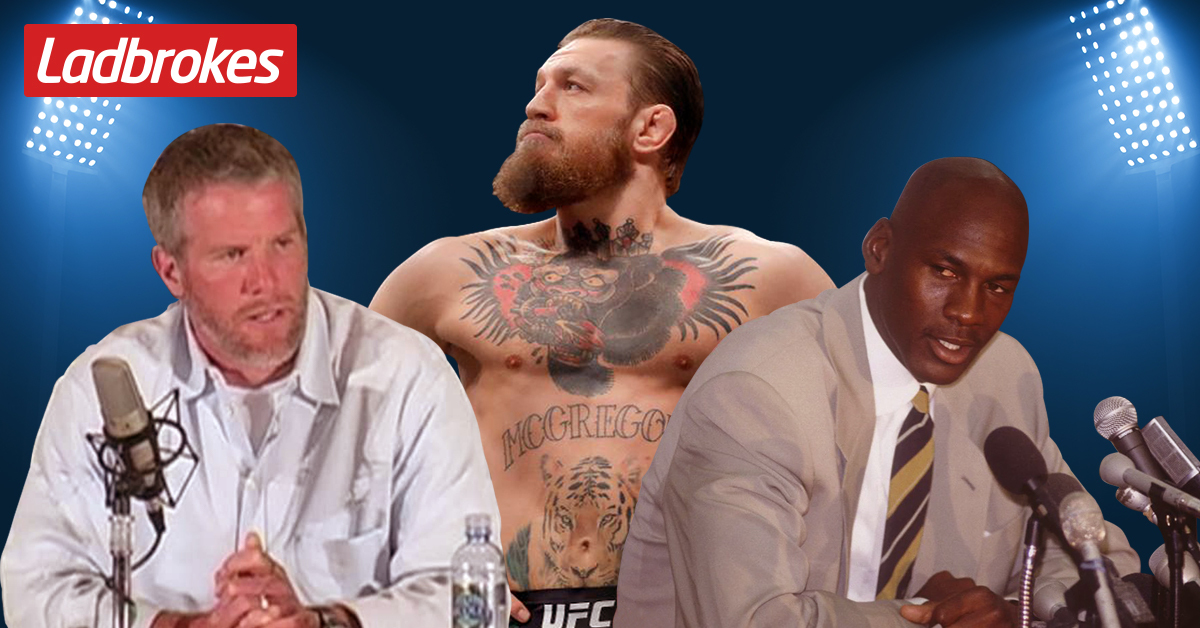

Always desperate for the limelight, Conor McGregor put out a Tweet in the immediate aftermath of UFC250 claiming that he is going to retire from fighting.
On the surface it would make a lot of sense, he’s made a lot of money, has a side business to keep the cash rolling in and getting punched and kicked in the head repeatedly would (we assume) get old quite quickly.
Forgive us if we’re sceptical about this “major announcement” though, after all McGregor has retired twice before, he’s now fast approaching the territory of that friend who continually breaks up with their partner only to reunite a few weeks later.
Let’s be honest, we’ve been fooled by the Irishman before.
When it comes to letting the game go, some people have a more difficult time than others so we here at the Ladbrokes Blog decided to go back and look at some of the other short-lived retirements ahead of McGregor’s eventual backflip.
Lleyton Hewitt
Hewitt made sure he made the most of his “retirement” announcing his decision a full year in advance to allow himself a farewell tour in a whole lot of tennis tournaments around the world.
It all came to a conclusion at the 2016 Australian Open, with the hoopla firmly focused on Hewitt’s final appearance at Melbourne Park, which was brought to a sudden halt in the second round in a straight sets loss to David Ferrer.
12 months later, Hewitt had apparently had enough of being retired and returned to the doubles circuit, playing with various partners from 2018 through to 2020 while also serving as captain of the captain of the Aussie Davis Cup team and occasionally pitching in with a racquet during the doubles.
Roger Clemens
Roger Clemens loved a dramatic moment and for his fourth “unretirement” he really had to up the stakes.
Having already retired at the end of the 2003, 2004 and 2005 MLB seasons, before coming back in 2004, 2005 and 2006, he decided to make a big show of things to announce his return in 2007.
During a New York Yankees home game, he showed up in the owner’s box and made this statement, “Thank y’all. Well they came and got me out of Texas, and uhh, I can tell you it’s a privilege to be back. I’ll be talkin’ to y’all soon.”
A month later he was back on the mound pitching for the Yankees for the remainder of the season before leaving the ALDS with an injury before retiring for good… we think.
Luke Hodge
Hodge had the fitting farewell in 2017, carried off the field by his Hawks teammates (alongside Bob Murphy from the Bulldogs) bringing down the curtain on a career that included four AFL Premierships.
But that itch for the game came back pretty quickly and before you knew it, Hodge was traded to the Brisbane Lions that October, where he played out two more seasons at a remarkable level, helping to guide the Lions to the AFL Finals for the first time in a decade.
Michael Jordan
Jordan might be the greatest basketball player of all time, but he sure loves a retirement speech, they probably could have given his retirement speeches their own episode on The Last Dance if they wanted to.
He gave his first one in 1993, retiring with three straight NBA titles before going and playing baseball for 18 months.
After coming back in 1995 and winning three more NBA titles, he left the game again in 1998 and moved into the front office of the Washington Wizards.
That infamous competitive fire got the better of him in 2001, coming back for two seasons with Washington in a largely forgettable stint where he criticised his teammates and looked like a shell of his former self.
Now the owner of the Charlotte Hornets, we wouldn’t be surprised if MJ decided he could still put up 20 points per game and came out of retirement in his 50’s.
John Farnham
You need to send the math to NASA to work out how many times John Farnham has retired and then made a comeback.
Farnham first announced his decision to retire in 2002, but he has released several albums and had about 100 “final” tours since then.
You’re The Voice is a banger though!
Allen Iverson
Allen Iverson was an athlete prone to spur of the moment decisions during his NBA career and it should come as no surprise that he threatened to retire on a number of occasions.
Despite announcing his retirement on December 3, 2009, AI was back playing less than a week later, although in a total power move he held that retirement threat over the 76ers for the rest of the season.
It was one way to get out of practicing, since he wasn’t a big fan of that part of his job.
Lance Armstrong
Talk about your all-time backfires, Lance Armstrong’s comeback from retirement cost him everything.
Had he stayed off the bike after leaving the sport following a seventh Tour de France in 2005, the truth about his career may never have surfaced.
Ultimately, his 2009 comeback backfired as he did not win another Tour, his cheating was brought into the public spotlight and is now one of the most hated athletes in the world.
His recent documentary with ESPN did him no favours as well, it would have soured his reputation even further if it wasn’t already so far in the gutter.
Mario Lemieux
After 13 seasons with the Pittsburgh Penguins, Mario Lemiuex retired in 1997 due to a battle with cancer and was immediately inducted into the NHL Hall of Fame, having the traditional three year waiting period waved.
Having recovered and with his team in financial trouble, Lemieux assumed part ownership of the team in 1999 thanks to deferred salaries and cash credits, also joining the team’s front office to re-stabilise the organisation.
That time with the team gave him the itch to come back as a player, putting him in a very rare position being owner of a team and a player as well.
A year later he was back on the ice aged 35 and played another six seasons before retiring for good
Brett Favre
For most of the early 2000’s every December and January brought about the debate over whether or not Green Bay Packers quarterback Brett Favre would retire.
Eventually, the “will I/won’t I” game got old and the Packers called his bluff, drafting Aaron Rodgers to be his eventual successor.
After a career resurgence in 2007, Favre took his team to the NFC Championship, throwing a critical interception in overtime to cost his team the game.
He quit the NFL in a teary press conference in March 2008, with this phrase the standout “I always will be a Packer”.
That should have come with the caveat, “… unless I don’t want to be” since a few months later, the inevitable comeback happened during training camp.
Only this time, the Packers had decided enough was enough, it was time for Rodgers, for better or worse, so they traded Favre to the New York Jets, mostly to keep him away from division rival Minnesota.
An injury plagued season in New York was made worse after he was found to be sending inappropriate texts to Jets Gameday host Jenn Sterger and he retired again after the 2008 season.
Nobody believed that was going to stick and it didn’t, the Jets released him in May 2009 and by August he had signed with the Vikings, guiding them to the NFC Championship where (déjà vu alert) he threw a crucial interception late in the game, costing the Vikings a shot at the Super Bowl.
His final season in 2010 was forgettable as injuries ended his ironman streak of consecutive starts and finally, he retired for good.
Either way, at least he had his revenge on the Packers.
Rob Gronkowski
If you thought Favre was dramatic, Rob Gronkowski’s see-sawing was a lot more painful to deal with.
Undoubtedly one of the best tight ends to ever play the game, Gronk wrestled with retirement for a few years before finally pulling the plug after winning Super Bowl 53 with New England.
With his body on the verge of breaking, including a severe back problem, few could blame him for walking away while he could
It was a sad moment as one of the NFL’s biggest personalities was brought down by injuries… allegedly.
After a few desperate attempts to stay relevant like appearing in the WWE, a couple of NFL pregame shows, some bizarre ads and an odd Super Bowl party, Gronk realised people didn’t care about him when he wasn’t on the field.
With his buddy Tom Brady now in Tampa Bay, where things were a little less regimented than they were in New England, Gronk’s body was magically healed.
Our resident Patriots fan in the office is taking the under on the number of games Gronk plays in 2020 (he’s not bitter at all).
Every Boxer Ever
Name a boxer and at some stage they have retired and then made a comeback – even Rocky Balboa.
Floyd Mayweather has hung up the gloves plenty of times but always seems to come back for the right price.
The great one, Muhammad Ali, also isn’t exempt from this list.
Already suffering from Parkinson’s disease, Ali requested a title fight against Larry Holmes.
Unfortunately Ali’s condition saw him gassed by the 11th round, forcing his trainer to stop the fight.
Michael Clarke
Michael Clarke let the tears flow when he announced his retirement during the 2015 Ashes Series but in less than six months, he realised he had made a terrible mistake.
Nobody was entirely certain why Clarke would come back, since the Aussie’s didn’t really need him and he was omitted from the test team.
Mark Henry
This may be the shortest retirement in the history of ‘sport’.
The World’s Strongest Man Mark Henry announced his retirement on an episode on Monday Night Raw, but seconds later he attacked WWE Champion John Cena to set-up a WWE Title Match at the next PPV.
How pimp is that pink suit?